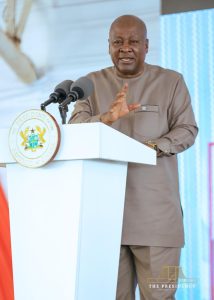
President Mahama Inspects Construction of Asunafo North Farmers Services Centre

President John Dramani Mahama has inspected ongoing construction works on the Farmers Service Centre at Asunafo North in the Ahafo Region as part of efforts to expand access to modern agricultural services, improve crop yields and increase farmers’ incomes.
The centre is part of the government’s plan to establish 50 Farmers Service Centres in areas with strong agricultural production to provide farmers with improved seeds, modern farming technologies, extension services and reliable markets for their produce.
The project sits on a 10 acre land, with four acres allocated to the construction of the Farmers Service Centre infrastructure, while the remaining six acres are being developed into an agro-processing centre to accommodate silos and processing equipment.
The agro-processing facility is expected to support the handling, storage and processing of agricultural produce, complementing the services provided at the Farmers Service Centre.
President Mahama explained that the Asunafo North facility was the second Farmers Service Centre whose construction he had personally witnessed, following an earlier sod-cutting ceremony for the first centre at Afram Plains.
“Not long ago, we visited the Afram Plains to cut the sod for the construction of the first Farmers Service Centre. This facility at Asunafo North is the second centre whose construction I have personally come to witness,” he said.
He disclosed that construction was ongoing at 15 Farmers Service Centres, adding that the Minister for Finance would make the necessary budgetary allocations to enable work to begin on the remaining facilities.
President Mahama said the centres would help farmers adopt modern agricultural practices and technologies to increase crop yields, reduce production costs and improve their incomes.
He cited maize production as an example, noting that farmers in Ghana obtained about two tonnes per hectare, compared with yields of between seven and nine tonnes per hectare in other parts of the world.
“One of the main purposes of the Farmers Service Centres is to educate farmers on modern farming methods and help them adopt improved agricultural practices that will increase their yields,” he stated.
The President also outlined plans to connect farmers to the centres through mobile phone applications, allowing them to obtain information, seek assistance and receive guidance on their farming activities.
Extension officers would also visit farms periodically to assess crop conditions, monitor farming activities and provide technical advice to improve production.
President Mahama said the centres would provide farmers with access to improved seeds, explaining that seed varieties differed in their yield potential and that the use of suitable, high-quality seeds could make a difference in agricultural output.
He added that agricultural research stations were working to identify and develop improved varieties, while the government would explore importing suitable seeds from countries such as Zambia when they were not readily available locally.
Another feature of the initiative would be a minimum guaranteed price for selected agricultural produce. Under the proposed arrangement, the government would announce a minimum price at the beginning of the year, taking into account production costs and farm inputs.
Farmers would remain free to sell at higher prevailing market prices. However, where market prices fell below the guaranteed rate, the government would purchase the produce and channel it through relevant public institutions, including the National Food Buffer Stock Company.
President Mahama said the arrangement would provide farmers with a market for their produce and support food supplies to schools, hospitals and correctional facilities.
He expressed confidence that the establishment and full operation of all 50 Farmers Service Centres would improve agricultural practices, raise productivity and increase farmers’ incomes.
Richard Aniagyei, ISD