President Mahama Challenges Researchers to Solve Problems, Not Just Publish Papers
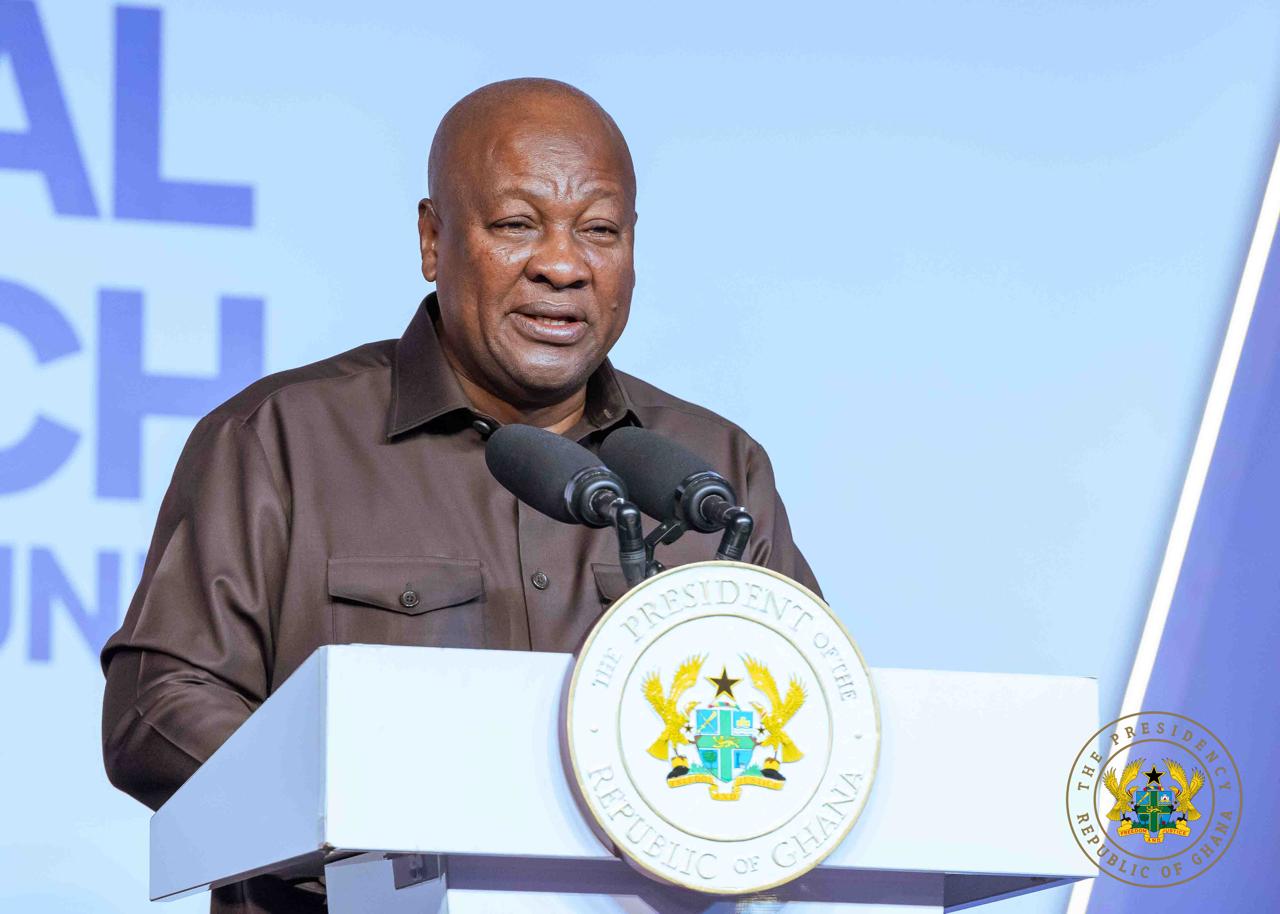
President John Dramani Mahama has challenged Ghana’s universities, research centres, and scientific institutions to raise their ambitions with the launch of the Ghana National Research Fund, saying the goal is not to produce more papers but to deliver solutions that can be commercialised and scaled.
Speaking at the launch, the President said the establishment of the fund must not merely increase grant applications but must increase ambition across the research community.
“Our objective is not simply to publish more papers. Our objective is to solve more problems,” he said.
President Mahama called on flagship institutions, including the Council for Scientific and Industrial Research and the Ghana Atomic Energy Commission, to use the fund to advance applied research, accelerate innovation, and translate scientific discoveries into practical solutions that create jobs, improve livelihoods, and support economic growth.
He pointed to specific challenges he wants researchers to tackle, including developing cocoa species resistant to swollen shoot disease, scaling up cotton farming resistant to the boll weevil, and producing non-toxic organic pesticides to reduce Ghana’s dependence on imported chemicals.
He said Ghana currently imports hundreds of millions of dollars worth of pesticides annually, many of which are no longer in use even in the countries that manufacture them.
“If our researchers have discovered a non-toxic organic pesticide, how do we scale that up so that our farmers have access to it? This is the gap the Ghana National Research Fund is coming to fill,” he said.
He acknowledged that Ghanaian researchers had already done well, developing many innovations, but said the major problem had been translating research into commercial production. The fund, he said, was designed to bridge that gap.
The President urged researchers to pursue breakthrough solutions in food security, develop climate-smart technologies for African agriculture, lead research into tropical diseases, and harness artificial intelligence to improve governance and public service delivery.
He also pointed to the rapidly changing global technology landscape, noting that artificial intelligence, biotechnology, automation, and digital technologies were reshaping economies and labour markets.
He cited the World Economic Forum’s identification of analytical thinking, technological literacy, creativity, and systems thinking as defining capabilities for the future economy, saying these were precisely the capabilities that a strong research system could help develop.
Countries that rely entirely on imported technologies, data, and expertise, he said, will always remain vulnerable.
“The future belongs to nations capable of generating their own solutions to their challenges. Ghana must be one of those nations,” he said.
“Let us create innovations that can be commercialised, exported, and scaled up globally,” he added.
Richard Aniagyei, ISD