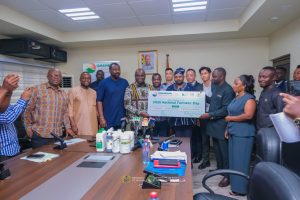
Deputy Agric Minister Calls for Swift Certification of Local Seeds

The Deputy Minister for Food and Agriculture, John Dumelo, has urged the newly inaugurated National Seed Council to expedite the certification of locally developed seeds to support government efforts to reduce dependence on imported seeds and improve agricultural productivity.
He said the council’s work would be central to ensuring that Ghanaian seed companies quickly obtain the certification required to introduce quality seeds onto the market.
He made this statement on Thursday at the inauguration of the nine-member National Seed Council in Accra.
He described quality seeds as the foundation of the country’s agricultural value chain, saying government investments in fertilisers, irrigation, mechanisation and farm service centres would deliver the desired results only if farmers had access to certified seeds.
He said Ghana was working to reduce seed imports by promoting the development and certification of locally produced seed varieties, adding that the council had an important responsibility to speed up the processing of seed applications.
“If you look at the seed situation in Ghana, you will realise that we are trying as much as possible to reduce seed importation and to certify home grown Ghanaian seeds, and that is where the council comes in specifically. We urge you to expedite those seed applications that come so that it becomes easier for home grown Ghanaian companies to be able to get the certification that they need so that the seeds come onto the market,” he said.
Mr Dumelo called on the council to serve with dedication and commitment as they carry out their responsibilities.
He stated the need for improved seed varieties capable of withstanding drought, pests and diseases, noting that changing climatic conditions made innovation in seed development increasingly necessary.
The Chairman of the council, Alhaji Mumuni, thanked President Mahama for the confidence reposed in the members and pledged their commitment to advancing Ghana’s seed sector.
He said the council would work diligently to meet expectations and contribute to the development of the agricultural sector.
Alhaji Mumuni said the council brought together experienced professionals from key institutions, including the Council for Scientific and Industrial Research, whose expertise would support the council’s mandate.
He added that members were ready to work together and quickly implement initiatives to strengthen seed development, certification and distribution across the country.
Other members of the council are the Director General of the Council for Scientific and Industrial Research, Prof. Michael Darko Asante; the Director of the Crop Services Directorate, Dr Solomon Gyan Ansah; the Director of the Plant Protection and Regulatory Services Directorate, Eric Bentsil Quaye; a representative of the Seed Growers Association of Ghana, Francis Kwasi Adjalo; a representative of the National Farmers’ Association, Ebenezer Kwabena Asante; a representative of the Biotechnology and Nuclear Agriculture Research Institute, Prof. Michael Yaw Osae; and presidential nominees Peter Boamah Otokunor and Agnes Kusi.
The National Seed Council has been established to regulate, certify and oversee Ghana’s seed industry.
It is expected to facilitate the timely certification of locally developed seeds, strengthen the country’s seed sector and ensure farmers have access to certified, high-quality seeds.
Irene Wirekoaa Osei, ISD