Misinformation Could Undermine Ghana’s Vaccine Research Efforts – President Mahama Warns
Ghana’s ambition to develop its own vaccines will depend partly on the willingness of citizens to participate in clinical trials, President John Dramani Mahama has cautioned.
He urged the public not to allow misinformation and fear to undermine scientific research, explaining that clinical trials are necessary for testing vaccines and building the country’s capacity to produce them.
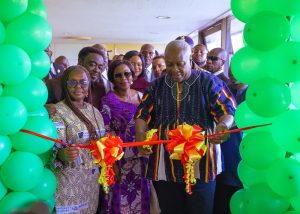
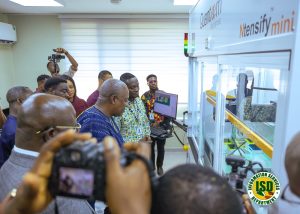
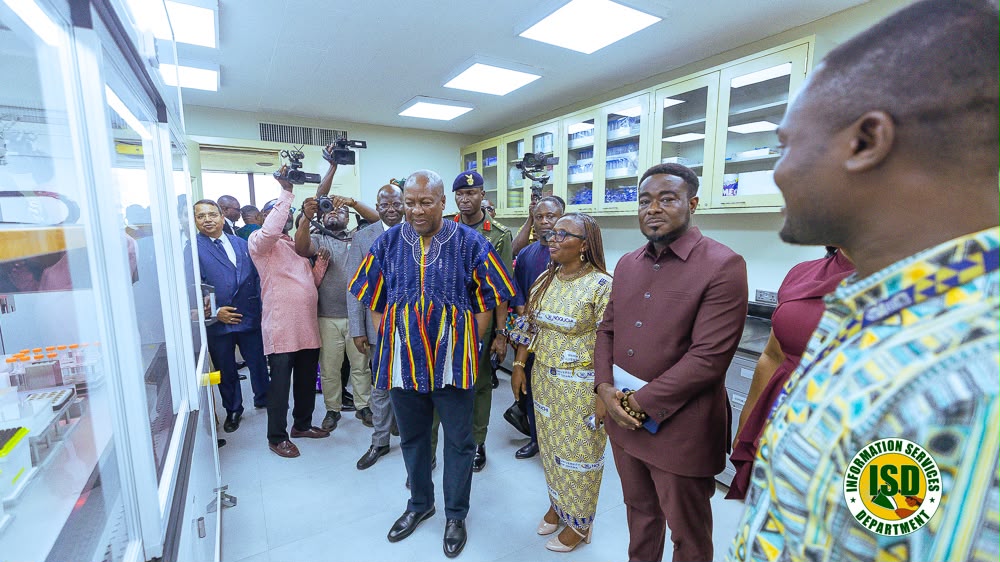
President Mahama made the appeal during the commissioning of vaccine research laboratories at the Noguchi Memorial Institute for Medical Research at the University of Ghana on Wednesday.
He recalled an earlier attempt during the Ebola outbreak to organise vaccine clinical trials in the Volta Region through researchers from the University of Health and Allied Sciences.
According to him, the proposed exercise was affected by public misinformation, with claims that the government intended to use residents of the region as guinea pigs by exposing them to the Ebola virus.
President Mahama said the misinformation eventually forced researchers to move the proposed trial outside Ghana.
“And Professor Binka of Blessed memory, may he rest in peace, I was informed he passed away a few days ago, Professor Binka of Blessed memory and some other researchers wanted to organize clinical trials from the University of Health and Allied Sciences. And it was supposed to be somewhere in the Volta region. And suddenly there was scaremongering,” he said.
He continued: “They said I decided to use Voltarians as guinea pigs. I was coming to infect them with Ebola and all that. Eventually the trial had to be taken to East Africa, I think, to Uganda or somewhere like that.”
The President said such public resistance could undermine Ghana’s efforts to develop the scientific expertise and infrastructure required to produce vaccines locally.
He explained that clinical trials form an essential part of vaccine development because they enable researchers to assess how vaccines work and how participants respond to them.
President Mahama therefore urged Ghanaians to understand the role of clinical research and support credible scientific processes rather than allowing rumours to derail them.
“And so if we are developing our own internal capacity to develop vaccines, we must accept to take part in the clinical trials. Nobody will do the clinical trials for us to develop vaccines in our country. And so that is my message to you,” he stated.
The President’s appeal comes as Ghana expands its vaccine research capacity through the newly commissioned mRNA and protein laboratories at Noguchi.
He said the facilities would provide scientists with the infrastructure to conduct research, test new ideas and collaborate with researchers locally and internationally.
He noted that Ghana was among five African countries using innovative mRNA technology to research and develop new vaccines, adding that the country was positioning itself to contribute to vaccine development on the continent.
President Mahama also commended the National Vaccine Institute for working with the Africa Centres for Disease Control and Prevention, the International Vaccine Institute and other institutions in Europe and the United States to strengthen Ghana’s research capacity.
He disclosed that five Ghanaian scientists had received training in Brussels and Accra and were ready to train other researchers in the use of the mRNA technology.
The five scientists are Professor Linda Eva Amoah, Professor Peter Kojo Quashie, Professor Augustina Angelina Sylverken, Dr Ruben Jani-Ayuvo and Dr Festus Kojo Acquah.
The President encouraged universities and research institutions to strengthen mentorship and collaboration, particularly to give young scientists opportunities to develop their expertise within Ghana.
He said public participation in clinical trials, combined with investment in research facilities and the training of scientists, would help the country build the capacity to develop vaccines and respond to its health needs.
Richard Aniagyei, ISD