National Peace Council Calls for Sustained Collaboration to Address Bawku Conflict
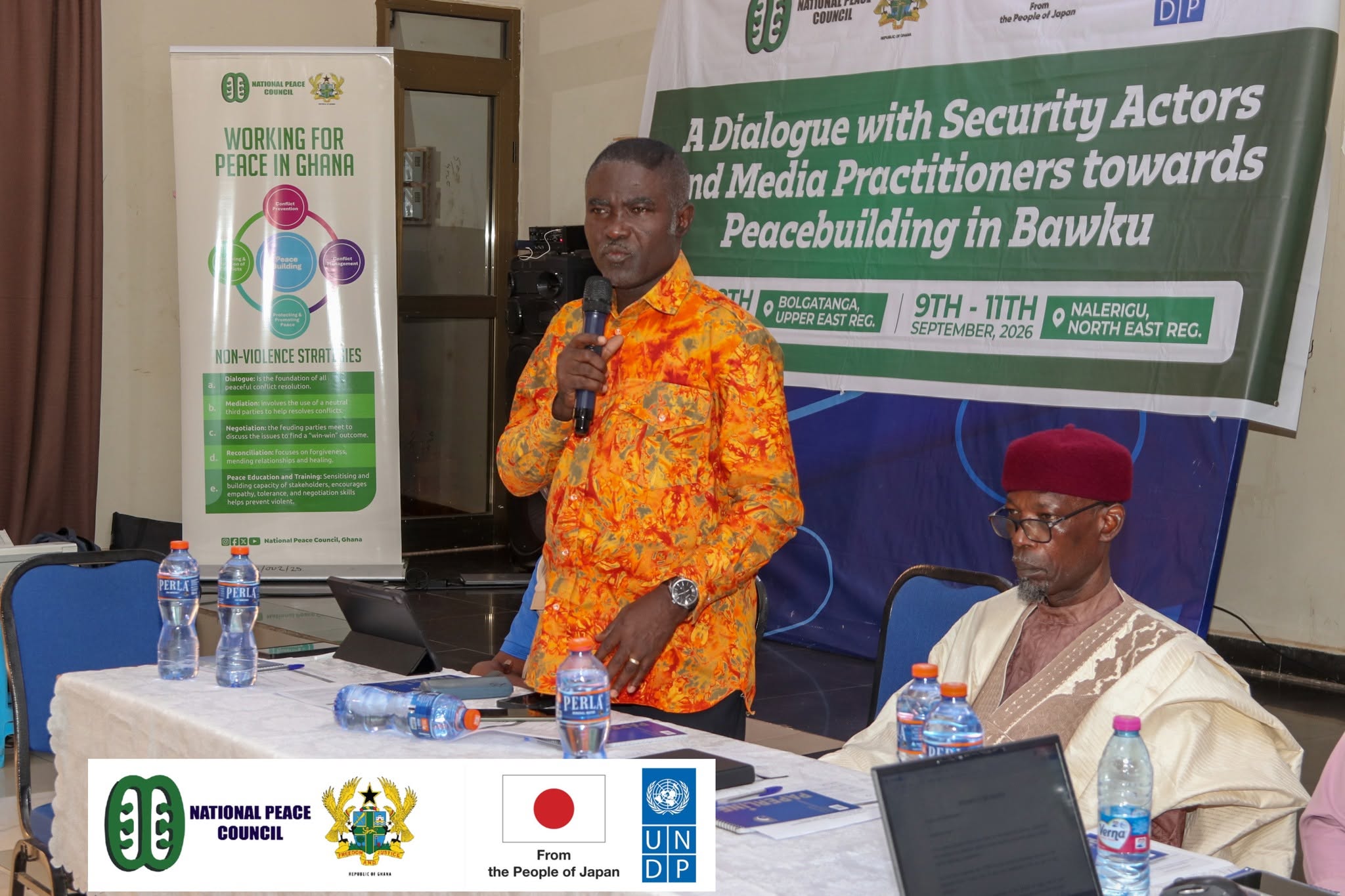
The Executive Secretary of the National Peace Council (NPC), Dr George Amoh, has called for sustained collaboration among state institutions, security agencies, the media, traditional authorities, civil society organisations and communities to address the protracted Bawku conflict.
He said lasting peace in Bawku could not be achieved by the efforts of a single institution or group, but required a coordinated and sustained approach involving all stakeholders.
He made the call at a two-day media and security dialogue organised by the National Peace Council in Bolgatanga, with funding support from the Embassy of Japan through the United Nations Development Programme (UNDP).
According to him, the NPC had placed the Bawku conflict at the centre of its peacebuilding activities for the year because of the complexity and prolonged nature of the conflict.
He said the Council had engaged key stakeholders to better understand the outstanding issues and identify appropriate short-, medium-, and long-term interventions to address them.
He stressed that effective peacebuilding required stakeholders to understand how their actions and decisions could either contribute to stability or worsen existing tensions.
He said the NPC would continue to facilitate dialogue and engagement among stakeholders as part of efforts to find sustainable solutions to the Bawku conflict.
A Member of the Governing Board of the National Peace Council, Sheikh Armiyawo Shaibu, also called on Ghanaians, particularly security actors and media practitioners, to take collective responsibility for de-escalating the Bawku conflict and restoring lasting peace.
He said the conflict had moved beyond the two main groups directly involved and had assumed a national dimension, requiring all citizens and institutions to contribute to efforts to restore peace and social cohesion.
“We all owe ourselves a duty to be part of those who undertake this sacred duty given to us by God, at every position that we are in, to de-escalate tensions in the Bawku conflict because it has gone beyond just the two factions and is now a national problem,” he stated.
Sheikh Shaibu urged the security agencies to use the dialogue to strengthen intelligence gathering, inter-agency cooperation and problem-solving while adhering to their mandates, professionalism and standard operating procedures.
He also challenged the media to exercise greater responsibility in reporting the conflict, stressing that journalists had a moral and ethical obligation to ensure that their reportage did not contribute to heightened tensions.
The Upper East Regional Minister, Donatus Akamugri Atanga, in a speech delivered on his behalf, commended the National Peace Council for convening the engagement.
He also commended the security agencies and traditional authorities for their restraint and commitment to maintaining the fragile peace and ceasefire that had prevailed in Bawku for three months.
The Minister noted that the security agencies and the media had a particularly important responsibility in the peacebuilding process, as their decisions, reportage and engagements with communities could either build confidence or deepen mistrust.
Judith Twumwaa, ISD