President Mahama, Queen Máxima discuss financial inclusion and economic security
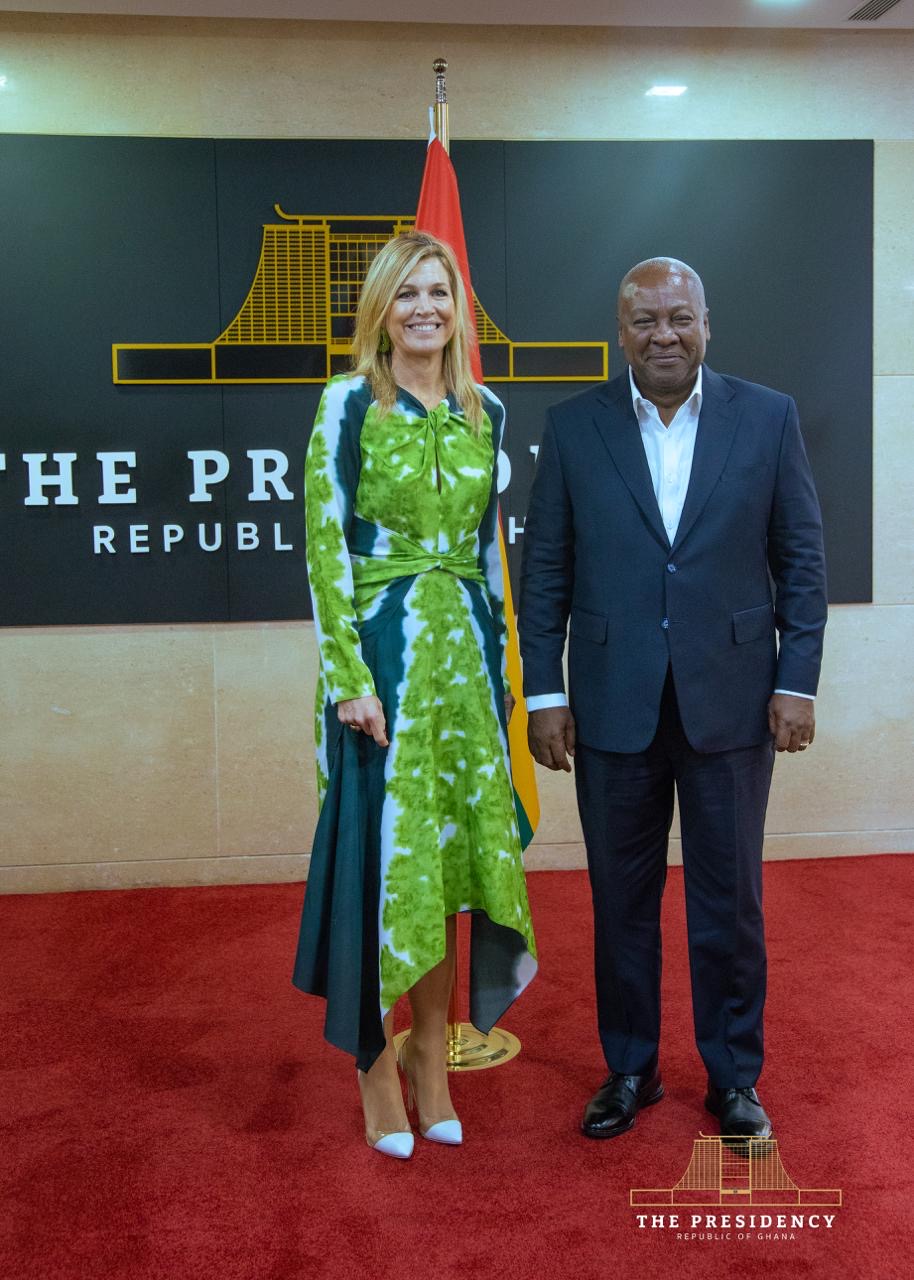
President John Dramani Mahama has held discussions with the United Nations Secretary-General’s Special Advocate for Financial Health (UNSGSA), Queen Máxima of the Netherlands, on measures to improve financial health and expand access to financial services for Ghanaians, particularly women, informal sector workers and smallholder farmers.
The discussions focused on developing tailored financial solutions to help individuals and households manage everyday expenses, withstand unexpected financial shocks, build savings and secure their long-term financial future.
Key issues included digital innovation, data sharing among financial service providers, long-term savings and pension arrangements for informal sector workers, consumer protection against fraud and scams, and simpler mechanisms for resolving customer complaints.
Queen Máxima said Ghana could build on its economic recovery to accelerate a national financial health agenda that would improve the financial security and livelihoods of households.
She called for the country’s next National Financial Inclusion and Development Strategy to incorporate clear financial health objectives and regular surveys to measure progress.
“What is the whole purpose of financial services? It is to improve people’s livelihoods. You have also done the huge work on bringing price stability. And of course, with fiscal stability, banks will be confident and invest in the real economy with flexible terms. So, the issue is how do we intentionally look into financial health,” she said.
Drawing on her financial health work in the Netherlands and engagements with employees at HPW’s dried-fruit processing facility in Adeiso, Queen Máxima also highlighted the role of employers in improving workers’ financial wellbeing.
She observed that financial stress could affect employees’ health, concentration and performance at work, making workplace interventions an important part of efforts to improve financial security.
President Mahama, on his part, emphasised the need to expand women’s access to finance, citing government’s plans to establish a Women’s Development Bank to provide capital and guarantee mechanisms to support women-owned businesses.
The proposed bank is expected to help women expand their businesses, increase their incomes and overcome some of the financing constraints that limit their economic participation.
He also outlined measures to make mortgage financing more affordable and deepen financial inclusion through digital infrastructure.
As part of these efforts, the President spoke about plans to ensure that every Ghanaian captured in the National Identification database has a digital wallet on their identification card.
He further highlighted the need to improve access to the digital network by upgrading rural telephony infrastructure to 4G, enabling more people in underserved communities to access digital financial services.
The discussions also addressed the need for financial products that enable households to build savings, obtain insurance against unexpected setbacks and plan for their long-term financial needs, particularly through pension arrangements for informal sector workers, many of whom currently lack pension coverage.
According to the World Bank’s Global Findex 2025, 81 per cent of adults in Ghana had a financial account in 2024, compared with 29 per cent in 2011.
However, the report also indicated that around one in three adults had bought groceries on credit or arranged to pay for them later in the preceding year, pointing to the financial pressures many households continue to face.
The engagement therefore examined how expanding access to financial services could go beyond account ownership to help people manage financial obligations, build emergency savings and become more financially resilient.
Both sides underscored the need for financial inclusion policies to focus not only on access to financial products but also on whether those products improve people’s ability to manage their finances, respond to unexpected difficulties and invest in their future
Richard Aniagyei, ISD