Vice President Calls for Renewed Social Contract to Strengthen Industrial Harmony
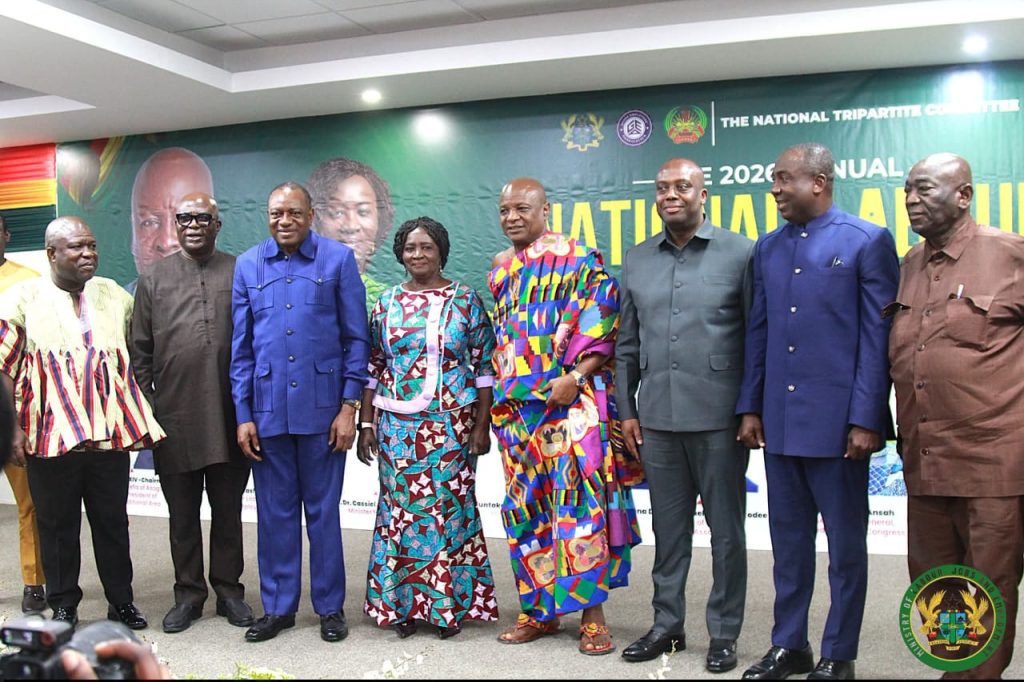
Vice President of Ghana, Professor Naana Jane Opoku-Agyemang, has called for a renewed social contract between government, employers and workers to preserve industrial peace and support Ghana’s economic transformation.
Speaking on behalf of the President at the opening of the 2026 National Labour Conference in Ho, the Vice President said sustainable development depends on dialogue, fairness and shared responsibility.
She described the annual conference as an important forum for addressing the concerns of workers and employers while shaping the future of work in Ghana.
She urged stakeholders to pay greater attention to workers in the informal economy, noting that they make up the majority of Ghana’s workforce but continue to face limited labour protection.
Professor Opoku-Agyemang said government was beginning to see positive results from its economic reforms despite global economic challenges, stressing the need to maintain industrial stability as the country continues its economic recovery.
She announced that government plans to limit major public sector salary re-negotiations in 2026 but instead focus on targeted improvements in selected allowances while broader reforms to the national emoluments system are completed.
The Vice President reaffirmed government’s commitment to protecting pension funds, implementing the proposed Labour Bill 2026 and advancing the 24 hour economy policy to create more employment opportunities.
Chairman of the conference, Togbe Afede XIV, Agbogbomefia of the Asogli State, described labour as the foundation of national development, noting that the conference provides an opportunity for government, employers and organised labour to build consensus on labour issues and strengthen industrial relations.
The Minister for Labour, Jobs and Employment, Dr Abdul Rashid Hassan Pelpuo, said Ghana’s economic transformation requires cooperation among government, employers and organised labour based on mutual respect and a shared national purpose.
Dr Pelpuo observed that Ghana’s labour environment has remained relatively peaceful over the past one and a half years because of continuous engagement among the tripartite partners.
The Minister highlighted the recently launched Ghana Decent Work Country Programme for 2026 to 2030, developed with support from the International Labour Organisation, which seeks to promote productive employment, expand inclusive social protection and strengthen compliance with international labour standards, adding that stakeholders would soon reconvene to review the Labour Bill 2026 before it is submitted to Parliament.
President of the Ghana Employers’ Association, Nana Dr Emmanuel Adu Sarkodie, called for policies that improve productivity while addressing Ghana’s housing deficit through affordable home ownership.
He proposed a national housing programme to build 1.8 million affordable homes, saying the initiative could create hundreds of thousands of jobs each year while supporting manufacturing, construction and related industries.
The Secretary General of the Trades Union Congress, Mr Joshua Ansah, said industrial harmony goes beyond the absence of strikes and must be built on trust, fairness, dialogue and respect for workers’ rights.
While acknowledging the value of continuous engagement, he maintained that the right to strike remains a legitimate option when negotiations fail.
Mr Ansah called for the early completion of the Labour Bill review to ensure the new legislation reflects the views of organised labour and provides adequate protection for workers.
The 2026 National Labour Conference is under the theme, “Strengthening Industrial Harmony as a Catalyst for Accelerated Economic Growth and National Development.”
Grae Acheampong, ISD