NACOC Director-General Calls for Stronger Cross-Border Cooperation Against Drug Trafficking
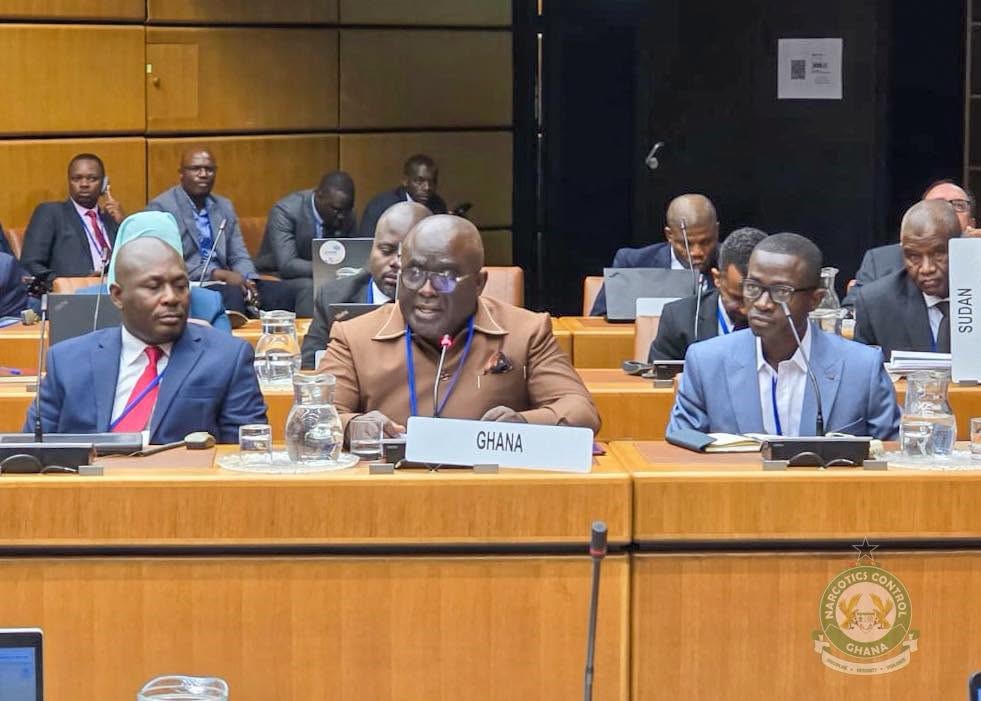
The Director-General of the Narcotics Control Commission (NACOC), Major-General Maxwell Obuba Mantey, has called for stronger and more practical cross-border cooperation among African countries to tackle the growing threat of synthetic drugs, cocaine trafficking and transnational organised crime.
He said the evolving nature of the illicit drug trade required African countries to move beyond fragmented national responses and strengthen intelligence sharing, coordinated investigations, joint operations and border management.
Major-General Mantey made the call at the closing of the 33rd Meeting of Heads of National Drug Law Enforcement Agencies, Africa (HONLEA Africa), held in Vienna, Austria.
According to him, trafficking networks were increasingly operating across multiple jurisdictions, moving synthetic drug precursors, cocaine and illicit financial flows through different countries while exploiting gaps in national enforcement systems.
He mentioned that no country, regardless of the strength of its law enforcement and border security systems, could effectively combat transnational drug trafficking alone.
“Cooperation is therefore not a diplomatic courtesy to be affirmed in closing statements; it is the operational prerequisite for any of our national strategies to be successful,” Major-General Mantey stated.
The NACOC Director-General advocated a neighbour-to-neighbour approach as a practical starting point for strengthening regional cooperation, particularly through intelligence sharing, joint patrols and coordinated border management.
He cited Ghana’s bilateral cooperation with neighbouring countries, as well as collaboration between The Gambia and Senegal, as examples of how direct cooperation between neighbouring states could provide a foundation for broader regional and continental action against drug trafficking.
Major-General Mantey also referred to the high-level dialogue hosted in Accra in November 2025 on “Mapping the Future of Drug Markets in West Africa – Synthetics, Cocaine, Criminal Money, and Strategic Responses.”
He said the issues raised at the Accra dialogue remained relevant, particularly the growing impact of synthetic drugs on young people and the potential for organised crime and illicit financial flows to undermine governance and state institutions.
He therefore called for a more practical, timely and operational approach to regional cooperation, where intelligence gathered in one jurisdiction could be quickly shared and used to support investigations and enforcement action in another.
He urged African countries to strengthen mechanisms for intelligence sharing, coordinated investigations, joint patrols and effective border management to disrupt trafficking networks before they could expand across jurisdictions.
Major-General Mantey reaffirmed Ghana’s commitment to strengthening bilateral and regional partnerships in the fight against illicit drugs and transnational organised crime.
He also pledged Ghana’s continued support to the United Nations Office on Drugs and Crime (UNODC) and other Member States in efforts to rebuild and reinforce cooperation against the illicit drug trade.
The 33rd HONLEA Africa meeting was chaired by Ambassador and Permanent Representative of the Republic of Ghana in Vienna, Austria, Her Excellency Matilda Alomatu Osei-Agyeman.
Judith Twumwaa, ISD