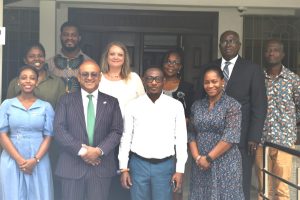
Digitalisation key to reducing corruption in public service – Professor Agyeman

The Chairman of the Public Services Commission (PSC), Professor Victor Kwame Agyeman, said the government’s digitalisation of public services aims to reduce human interaction, curb corruption, and improve efficiency in service delivery.
He said expanding public services through digital platforms would help eliminate opportunities for rent-seeking and other forms of corruption associated with face-to-face interactions between service providers and citizens.
Professor Agyeman made these remarks on Tuesday during a media engagement at the ongoing 10th edition of the Human Resource (HR) Café in Accra.
He said the government’s public service transformation agenda was anchored on three main priorities: efficiency in the public service, citizen-focused service delivery and fiscal discipline.
According to him, the government was working to ensure that public services were delivered efficiently, noting that the traditional perception that the private sector was more efficient than the public sector could no longer be sustained.
“The public sector provides more or less the vehicle for the private sector. And therefore, if one part is inefficient, the whole system becomes inefficient,” he said.
Professor Agyeman said digitalisation was particularly important in creating a citizen-focused public service because it allowed citizens to access services without unnecessary human interaction.
He cited passports, vehicle licensing, tax payments and other essential services as areas where government had introduced web-based platforms to improve accessibility and speed of service delivery.
He explained that citizens who required faster services could also access expedited services by paying the prescribed fees.
The PSC Chairman said the objective was to ensure that citizens received public services on time, while reducing rent-seeking behaviour and improving satisfaction with government services.
He said the transformation of public services was therefore not only about introducing technology but also about creating a more responsive system that met the needs of citizens.
Professor Agyeman also linked public service transformation to the broader development of human capital, saying Ghana and Burkina Faso needed to strengthen cooperation in developing the skills and capabilities required to drive economic growth.
He said human capital encompassed the experience, skills, education and health of people, all of which contributed to productivity and economic development.
On his part, the Head of the Human Resources Department of IAMGOLD Essakane SA, Comrade Adama Windketa Quedraogo, called on organisations to strengthen their strategies for attracting, motivating and retaining skilled employees to ensure long-term sustainability.
He said high employee turnover was becoming a growing concern for organisations, particularly as workers increasingly valued flexibility, productivity and the reputation of their employers.
Mr Quedraogo noted that organisations must invest in employee development while creating conditions that encourages workers to remain committed to their employers.
Joyce Adwoa Animia Ocran, ISD