NAP Exceeds Enrollment Target by 43% as 14,335 Apprentices Sign Up

The National Apprenticeship Programme (NAP) attracted more than 300,000 applications from young people across Ghana, leading to the enrolment of 14,335 apprentices against an initial target of 10,000, President John Dramani Mahama has announced.
The figures, which represent an enrolment performance 43 percent above the programme’s pilot target, reflect the demand for practical skills training among young people seeking opportunities to secure employment or establish their own businesses.
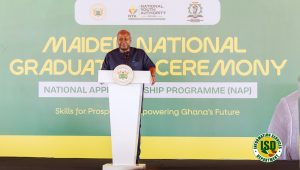
Speaking at the graduation ceremony of the first cohort, President Mahama said 13,309 of the apprentices had successfully completed their training, comprising 10,325 females and 2,984 males.
The graduates came from all 16 regions of the country, with 112 persons with disabilities also completing the programme.
The National Apprenticeship Programme was launched by the President in Tamale on April 30, 2025, as part of Government’s efforts to provide young people with practical and marketable skills that can improve their chances of securing jobs and participating in productive economic activities.
The programme covers a broad range of occupational areas, including agriculture and agro-processing, mechanical and electrical trades, carpentry, welding, plumbing, fashion and textiles, catering, creative arts, beauty and personal care, hospitality, tourism, renewable energy and information technology.
Training is structured around 70 percent practical instruction and 30 percent theory and entrepreneurship, with the duration ranging from three to 18 months, depending on the trade.
To help graduates move from skills acquisition into employment, President Mahama drew attention to the NAP Connect application, which is intended to link trained apprentices with prospective employers and people seeking their services.
He urged the graduates to download and use the application, explaining that it would help connect skilled workers, including welders and dressmakers, to individuals and organisations looking for their services.
The job-matching platform is expected to make it easier for graduates to showcase their skills and become accessible to potential clients and employers.
It also provides a link between the training received under the programme and the demand for skilled services in the economy.
President Mahama said the Government’s objective was to ensure that graduates did not remain at the end of their training without a clear pathway to employment or enterprise opportunities.
He therefore encouraged them to explore other Government initiatives that could support their transition into the labour market.
These include the Adwumawura Programme, which is expected to provide startup capital for young people seeking to establish businesses, and the Women’s Development Bank, which is intended to support women in enterprise.
Graduates may also benefit from employment opportunities expected under the 24-hour economy initiative, while those interested in digital careers can build additional competencies through the One Million Coders Programme.
The President further indicated that Government was pursuing labour mobility agreements to create opportunities for skilled Ghanaian workers in the Caribbean and the Middle East.
The arrangements are expected to involve fixed-term employment contracts, mostly lasting about five years.
The strong response to the pilot has informed Government’s plans to expand the programme. President Mahama announced that at least 50,000 apprentices would be trained in 2027.
He also said Government intended to uncap the Communication Service Tax to release an additional GH¢1 billion to support programmes including NAP, Adwumawura and the Youth Employment Agency.
On inclusion, the President noted that although 112 persons with disabilities had graduated, their participation remained below the programme’s five percent target. He called for greater inclusion of persons with disabilities in the next cohort.
Female participation, however, exceeded expectations. Women accounted for 78 percent of the graduates, against a target of 40 percent.
The President encouraged more women to pursue technical and traditionally male-dominated trades such as electrical installations, plumbing, welding, carpentry, mechanical engineering, renewable energy and digital technology.
He said the programme would continue to be developed to give more young people access to practical training and improve the connection between skills development and employment.
Richard Aniagyei, ISD