NAP Targets 50,000 Apprentices for 2027 as Government Expands Skills Training
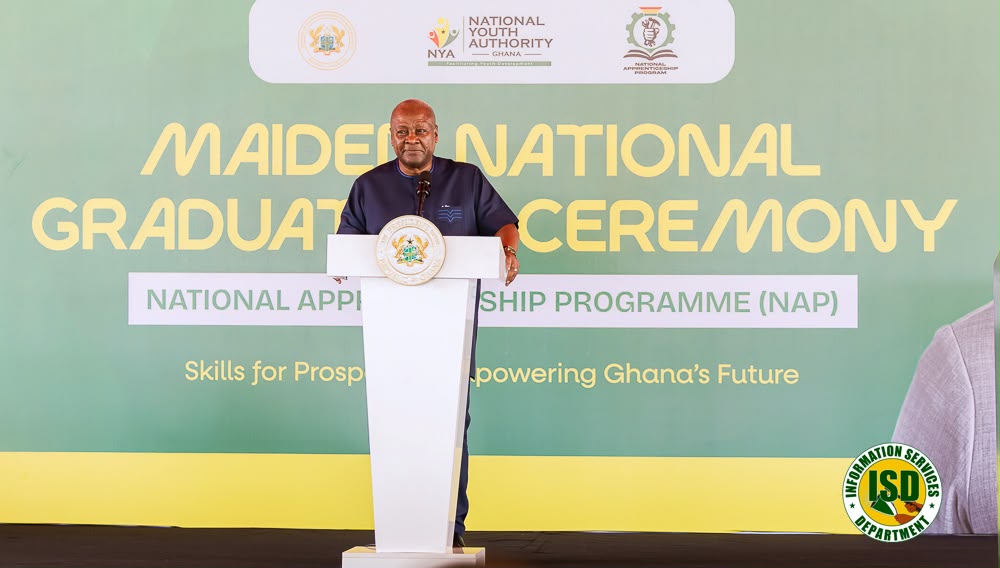
President John Dramani Mahama has announced plans to train at least 50,000 young people under the National Apprenticeship Programme (NAP) in 2027, as Government prepares to expand the initiative to provide more Ghanaians with practical skills and improve their access to employment.
The President made the announcement at the graduation ceremony of the first cohort of the programme, where he said the next phase would build on the results of the pilot and reach a much larger number of young people seeking technical and vocational training.
“Next year we are going to train at least 50,000 apprentices,” he announced.
The expansion follows what the President described as a strong response to the pilot programme, which attracted more than 300,000 applications from young people across the country. Although the initial target was to enrol 10,000 apprentices, a total of 14,335 were admitted, representing 43 per cent above the target.
Of those enrolled, 13,309 successfully completed their training and graduated. The graduates comprise 10,325 females and 2,984 males, drawn from all 16 regions of Ghana.
The programme was launched by President Mahama in Tamale on April 30, 2025, as part of Government’s efforts to equip young people with practical skills that respond to the needs of the economy and create pathways into employment and entrepreneurship.
Under the scheme, beneficiaries receive training in a wide range of fields, including agriculture and agro-processing, mechanical and electrical trades, carpentry, welding, plumbing, fashion and textiles, catering, beauty and personal care, hospitality, tourism, creative arts, renewable energy and information technology.
The training model places 70 per cent emphasis on practical instruction and 30 per cent on theory and entrepreneurship. Depending on the trade, the training period ranges from three to 18 months.
President Mahama said the programme was intended to move beyond classroom-based instruction by giving young people the practical experience and competencies required to work independently, secure jobs or establish businesses.
He also stressed the importance of ensuring that apprenticeship training leads to actual economic opportunities. Government is therefore pursuing links between the programme and other interventions, including the Adwumawura Programme, the Women’s Development Bank, the 24-hour economy initiative and the One Million Coders Programme.
The President further announced that Government intended to uncap the Communication Service Tax to release an additional GH¢1 billion to support interventions such as the National Apprenticeship Programme, Adwumawura and the Youth Employment Agency.
The increased funding is expected to support the Government’s broader youth employment and enterprise development agenda, including the planned expansion of apprenticeship opportunities.
President Mahama also urged the graduates to take their trades seriously, uphold professional standards and embrace innovation and technology to improve the quality of their work.
He said the success of the programme would not be measured only by the number of people trained but also by the opportunities graduates were able to secure and the businesses they could establish.
The target of 50,000 apprentices in 2027 is expected to extend the programme’s reach and give more young people the opportunity to acquire skills in areas that can support Ghana’s productive sectors.
Richard Aniagyei, ISD