Head of Local Government SERVICES URGES assemblies to implement new PRCC manual to improve complaints management
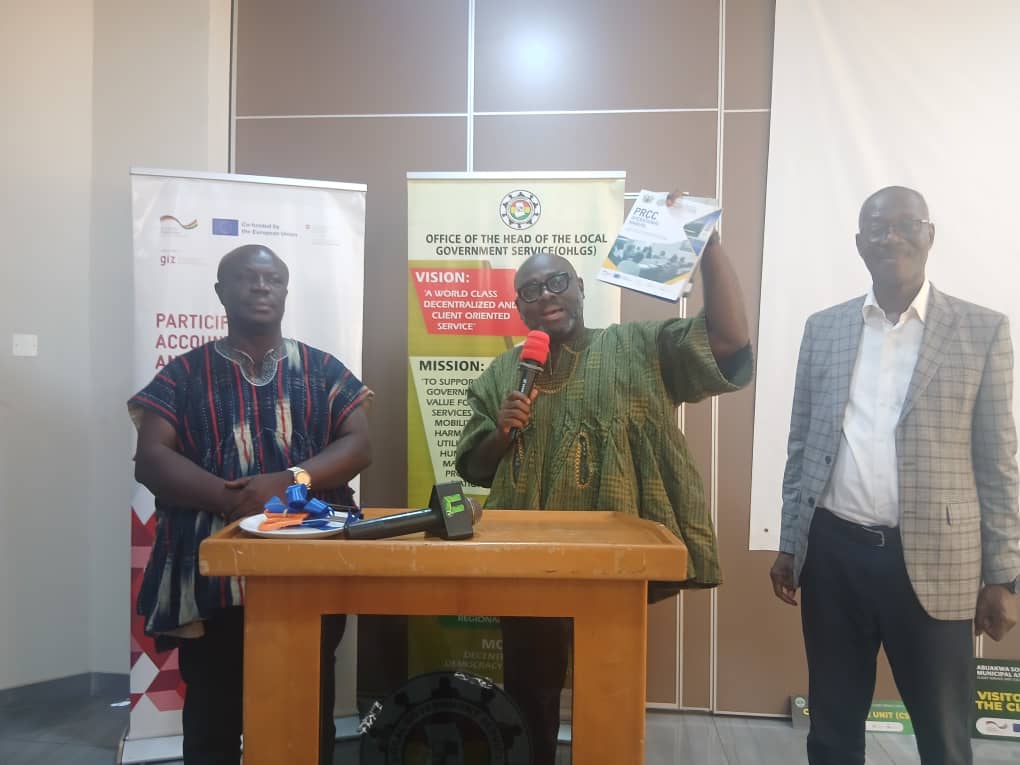
The Head of the Local Government Service, Professor Lord Kwaku Mensah, has urged Metropolitan, Municipal and District Assemblies (MMDAs) to effectively implement the newly launched Public Relations and Complaints Committee (PRCC) Operational Manual to improve complaints management, public engagement and service delivery.
He said the effectiveness of the manual and accompanying Client Service Unit (CSU) communication materials would depend on how well the assemblies adopted and applied them to address citizens’ concerns and improve their interactions with local government institutions.
Professor Mensah made the call at the official launch of the PRCC Operational Manual and CSU Communication Materials on Thursday in Accra, where he emphasised the need for local government institutions to strengthen their relationship with the people they serve.
He explained that local government institutions existed primarily to deliver services to citizens, adding that their performance should be measured not only by the policies they formulated and development interventions they implemented but also by how they communicated with the public and responded to their concerns.
He noted that the Public Relations and Complaints Committees, established under the Local Governance Act, 2016 (Act 936), provided an institutional platform for strengthening public relations, facilitating communication between assemblies and citizens, and ensuring the systematic management of complaints.
Similarly, he said the Client Service Units served as important contact points between the public and local government institutions by providing information, guidance and assistance to citizens in their dealings with the assemblies.
According to him, the newly developed operational manual would provide practical guidance for the effective functioning of the PRCCs, promote consistency in their operations and strengthen the handling of complaints and concerns raised by the public.
The CSU communication materials, he added, would improve the visibility of the units and help citizens understand the services and assistance available to them.
Professor Mensah cautioned the assemblies against allowing the newly launched materials to remain unused in their offices, insisting that they must become practical tools for improving institutional responsiveness and accountability.
“The manual should not remain a document on the shelves of our offices, neither should the CSU Communication Materials merely serve as display items,” he said.
He said the success of the initiative would ultimately be measured by improvements in citizens’ experiences when engaging with local government institutions.
“We must strive to create an environment where complaints are received and addressed systematically, information is readily accessible, and citizens are treated with courtesy, fairness and respect,” he stated.
Professor Mensah commended the Fair Programme, commissioned by the German Federal Ministry for Economic Cooperation and Development (BMZ), co-financed by the European Union and the Swiss State Secretariat for Economic Affairs (SECO), and implemented by the German Development Cooperation (GIZ) in collaboration with the Ministry of Finance, for supporting the development of the materials.
The Head of the Participation, Accountability, Integrity for a Resilient Democracy (PAIReD) Programme, Nils Furkolher, said the PAIReD Programme, implemented by the German Development Cooperation (GIZ), was working closely with the Office of the Head of the Local Government Service (OHLGS) and other institutions to strengthen accountability at the sub-national level.
According to him, the newly launched PRCC Operational Manual provides a common framework for assemblies to strengthen complaints management procedures, clarify responsibilities and improve reporting.
The CSU communication materials, he added, would help citizens better understand available services and improve access to information at the local government level.
Mr Furkolher disclosed that 46 of the programme’s 160 participating MMDAs had so far received training on the manual, while 16 officers from the Regional Coordinating Councils had been trained as trainers to support its wider dissemination.
Adwoa Koramah Anokye-Gyimah, ISD