IMO and GMA Partner to Strengthen Maritime Certification
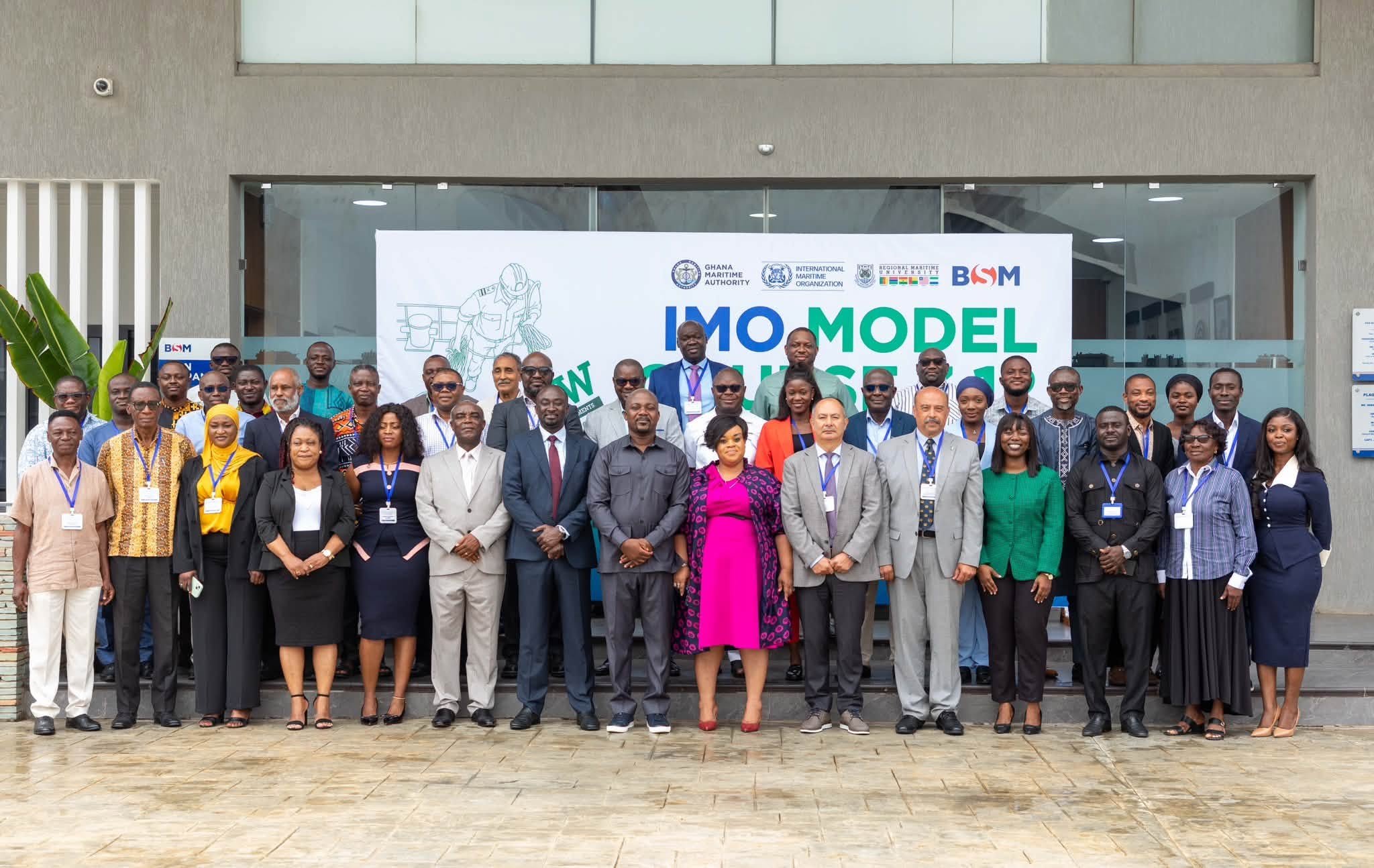
The International Maritime Organisation (IMO) and the Ghana Maritime Authority (GMA) have partnered to strengthen maritime safety and certification standards across West Africa,
The partnership was marked by the launch of a regional training program in Accra, designed to close competency gaps among seafarer certification examiners through a five-day workshop based on IMO Model Course 3.12: Assessment, Examination, and Certification of Seafarers.
Speaking at the opening, the Deputy Director General of the GMA, Mubarick Masawudu, noted the heavy responsibility resting on assessors, stating that certification extends far beyond basic paperwork.
“A Certificate of Competency represents a pledge that must hold water internationally, which is why consistency and integrity in our assessment systems are non-negotiable,” Mr Masawudu said.
He warned that if one administration’s credentials lose credibility, the resulting distrust could undermine the region’s standing in the global shipping industry.
Mr Masawudu said Ghana is determined to avoid such pitfalls by proactively strengthening assessor qualifications and examination frameworks well ahead of the IMO Member State Audit Scheme (IMSAS) in 2027.
The Deputy Director General also mentioned that as the global maritime spotlight increasingly turns toward Africa, the economic potential of ocean transport demands rigorous preparation and unwavering reliability.
“With the industry evolving rapidly each day, ensuring that every operational rope is tightly secured has never been more critical,” he said.
He added that raising the bar for the workforce through comprehensive training is not optional but essential for sustaining reliability and growth.
Mr Masawudu encouraged participants to use the workshop for honest self-reflection, scrutinising current practices, resolving inconsistencies, and adapting standards to meet evolving industry demands.
IMO Regional Representative for West and Central Africa, Capt. Dallas Laryea, reinforced that seafarer competence remains the cornerstone of maritime safety, security, and environmental protection.
He noted that as shipping undergoes rapid transformation driven by automation, digitalisation, and alternative fuels, strengthening certification credibility is more important than ever.
“This evolution requires future-ready seafarers equipped with a broad range of competencies, spanning from traditional seamanship to cyber awareness and the safe handling of new energy sources,” he said.
The Technical Officer in charge of the Maritime Training and Human Element Division at the IMO and Lead Facilitator, Milton Baron, explained that the course equips participants with practical tools to implement STCW provisions, organise standardised examinations, and manage certification lifecycles with precision.
He noted that with the rise of the blue economy and push toward decarbonisation, robust training is essential to prepare seafarers for evolving industry demands.
The program brought together 24 participants from Ghana, Liberia, Cabo Verde, Nigeria, The Gambia, and Sierra Leone, along with facilitators from the IMO headquarters in London.
Margaret Adjeley Sowah, ISD