President Mahama Courts Indian Partnerships to Strengthen Local Pharma Production
President John Dramani Mahama has invited Indian pharmaceutical companies to partner with Ghana to manufacture medicines locally, as government seeks to strengthen the country’s health sovereignty under the Accra Reset agenda.
The President said Ghana was open to partnerships that would support local pharmaceutical production and reduce the country’s reliance on imported medicines.
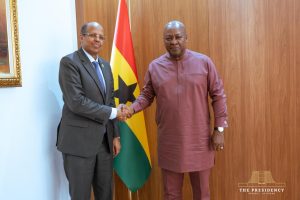
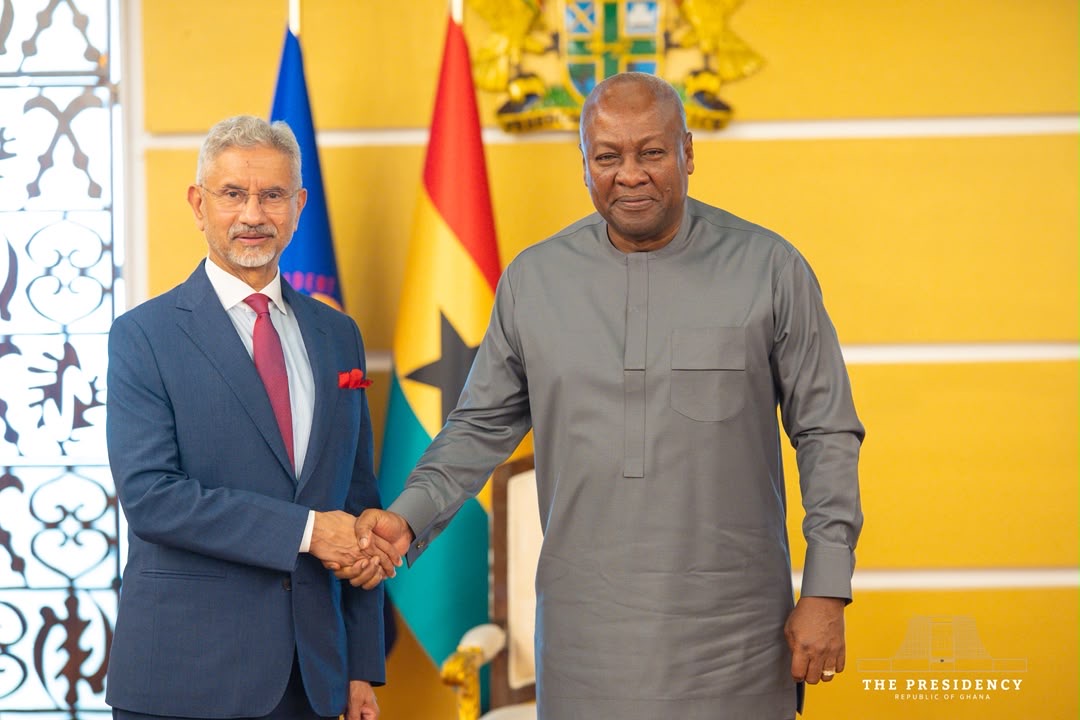
He made this known on Tuesday when he received India’s Minister for External Affairs, Dr Subrahmanyam Jaishankar, at the Presidency, where the two sides discussed opportunities to deepen Ghana-India cooperation in pharmaceuticals, rail infrastructure, trade and investment.
President Mahama said the pharmaceutical industry presented an important area for stronger collaboration between Ghana and India, particularly as Ghana seeks to build local capacity to produce medicines and other health products.
“On pharmaceuticals, we are open to partnerships to manufacture drugs locally,” he stated.
He said the policy formed part of the Accra Reset agenda, which promotes health sovereignty and seeks to strengthen Ghana’s ability to meet its own healthcare needs.
The President said there were already positive developments in the area of pharmaceutical cooperation between the two countries, pointing to the partnership between India’s Atlantic Life Sciences and Ghanaian pharmaceutical company KinaPharma.
“There are already positive signals. Currently, one of our major pharmaceutical companies, Atlantic Life Sciences, is from India and they are working closely with an indigenous company, KinaPharma, in developing vaccines for Ghana,” he said.
President Mahama said such partnerships could provide a basis for Ghana to expand its pharmaceutical manufacturing capacity while benefiting from the expertise, technology and investment of Indian companies.
The collaboration also comes as Ghana seeks to deepen its health sector partnerships beyond the traditional supply of imported medicines, with greater emphasis on building domestic production capacity.
The President said Ghana’s engagement with India was already producing results in other areas of the economy, citing the growth in trade between the two countries.
He disclosed that Ghana’s exports to India had increased from about US$3 billion to almost US$7 billion, driven mainly by goods exports, while Ghana continued to import agricultural machinery and automobiles, including buses, from India.
President Mahama said the growing commercial relationship provided an opportunity for both countries to explore additional areas of investment that could support Ghana’s industrial development.
He recalled existing Indian contributions to Ghana, including the Jubilee House, the Ghana-India Kofi Annan Centre for ICT and the Tema-Mpakadan Railway Line.
He also cited Indian Prime Minister Narendra Modi’s visit to Ghana in July 2025 and Minister Jaishankar’s subsequent engagement as signs of the growing relationship between the two countries.
Dr Jaishankar, for his part, conveyed greetings from Prime Minister Narendra Modi and President Droupadi Murmu and said India was committed to giving greater substance to the comprehensive partnership agreed between the two countries.
“And in fact, he is urging us that the comprehensive partnership that you and he decided upon was the task of the Foreign Ministers to give it more concrete shape to explore new possibilities and avenues for cooperation,” he stated.
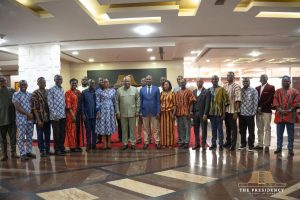
The meeting was attended by the Chief of Staff, Julius Debrah; Minister for Foreign Affairs, Samuel Okudzeto Ablakwa; and other Ghanaian and Indian officials.
Richard Aniagyei, ISD