President Mahama Visits Veteran Filmmaker Dr Chris Hesse, Acknowledges His Legacy
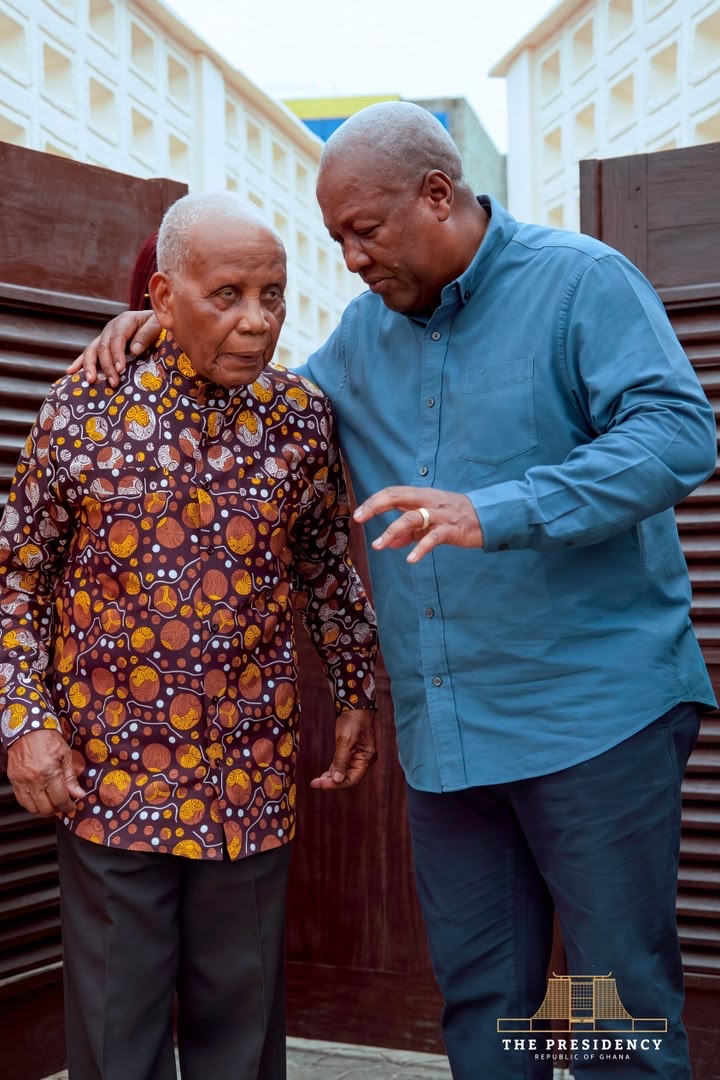
President John Dramani Mahama has honored veteran filmmaker and cinematographer Dr Chris Hesse for his longstanding contribution to Ghana’s film industry and efforts to preserve the country’s historical audiovisual heritage.
The President, who paid a visit to Dr Hesse, popularly known as Uncle Chris, on Monday recounted their longstanding relationship and the veteran cinematographer’s commitment to safeguarding historical film footage, including recordings from the era of Ghana’s first President, Dr Kwame Nkrumah.
President Mahama said his appreciation of Dr Hesse’s work grew when he served as Deputy Minister of Communications, during which the veteran filmmaker drew his attention to deteriorating historical film archives.
He recalled how Dr Hesse took him to see kilometres of film reels that had deteriorated over time, with some affected by mould and ageing, making their recovery difficult.
The President said efforts were subsequently made to salvage the films, although some could not be recovered because of the extent of their deterioration.
He attributed the situation to the period when Ghana’s film industry facilities were taken over by Malaysian investors, noting that the modernisation of the facility was prioritised while the preservation of the historical film archive was not adequately considered.
President Mahama said Dr Hesse later informed him that copies of some of the films had been preserved at the Rank Xerox laboratory in London, but Ghana had outstanding payments to the facility that threatened the continued storage of the footage.
He recalled making a case for the payment of the outstanding amount, which he said was about £10,000 at the time, to ensure that the films were not discarded.
“We managed to salvage some and took them away from there. But Uncle Chris told me, ‘You know what, we have copies of these films that are well preserved and they are in the Rank Xerox laboratory in London.’ And at that time we owed Rank Xerox I think £10,000 or something,” he recounted.
The President said the payments were subsequently made and continued for some time, but following a change in government after the 2000 elections, the arrangement was not sustained.
He said the films were eventually brought to Ghana and deposited at the country’s embassy, where they were kept in the basement.
According to President Mahama, Dr Hesse’s mission thereafter was to ensure that the historical footage was digitised and preserved for future generations, particularly as digital technology had become available to support the process.
He commended the veteran cinematographer for pursuing that mission, noting that some of the historic recordings, including early footage from the Nkrumah era, were now available digitally and circulating on social media.
“If you go on social media, you see some very early films from Nkrumah’s time. It is all the work of this man,” the President said.
President Mahama described Dr Hesse’s work as an important contribution to Ghana’s cultural and historical preservation, stressing the need for the country to recognise and honour individuals who have devoted themselves to safeguarding its heritage.
He said the visit was intended to celebrate Dr Hesse while he was alive, rather than wait until his death to acknowledge his contribution.
The President also acknowledged the recognition Dr Hesse had received through Eyes of Ghana, which has gained popularity, but said he wanted to personally visit and honour the veteran filmmaker.
“I said that we must honour you not posthumously. When you die, then we will start crying. We must do it while you are alive,” he said.
President Mahama expressed happiness at Dr Hesse’s appearance and health during the visit, adding that he hoped to emulate his fitness and wellbeing.
Dr Chris Hesse, a veteran cinematographer and former cameraman for Dr Kwame Nkrumah, has contributed to Ghana’s film and audiovisual history through his work in filmmaking and the preservation of historical footage, helping ensure that important records of the country’s past remain accessible to future generations.
Richard Aniagyei, ISD