Digital disinformation is worsening Africa’s security challenges- President Mahama Mahama warns

President John Dramani Mahama has warned that digital platforms are increasingly being used to spread disinformation, exploit public grievances and recruit young people into extremist groups, creating new challenges for African governments and security institutions.
He said the speed at which false information and extremist messages circulated online had exposed weaknesses in the way state institutions responded to emerging security threats.
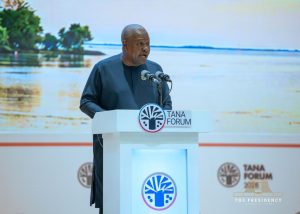
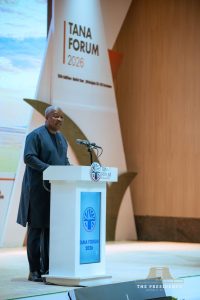
In his keynote address at the 12th Tana High-Level Forum on Security in Africa in Bahir Dar, Ethiopia, President Mahama identified digital transformation as one of four interconnected areas requiring attention in efforts to address insecurity across the continent.
He said digital connectivity and financial technology offered important opportunities for development but had also created an environment in which hostile actors could influence public opinion and deepen existing divisions.
“Our report sounds a loud alarm. The digital space has become an asymmetric war zone,” he said.
President Mahama cited external disinformation campaigns in the Sahel, where he said local grievances had been exploited to poison public discourse and contribute to conditions that could weaken democratic institutions.
He also warned that extremist groups were using platforms such as TikTok, WhatsApp and Telegram to communicate with and recruit frustrated young people.
“Extremist groups are out-communicating and out-innovating our state apparatuses on TikTok, WhatsApp, and Telegram, recruiting frustrated youth in real time,” he said.
The President contrasted the speed of online communication with the slower responses of regional and continental institutions.
“Meanwhile, our intergovernmental institutions are still responding with three-page communiques, drafted 72 hours late, while fighting 21st century digital insurgencies with 20th century bureaucracy,” he said.
He called for African institutions to improve their capacity to understand and respond to emerging threats, including the use of digital platforms by armed groups and external actors.
President Mahama also linked digital insecurity to broader problems of governance, economic exclusion and declining public trust, arguing that security strategies must address the conditions that make communities vulnerable to manipulation and extremist recruitment.
His presentation placed digital transformation alongside resource sovereignty, institutional effectiveness and regional integration as areas that require coordinated action by African governments.
The issue featured in the wider discussions at the Tana Forum, held under the theme, “Pathways to Peace in Africa: Economic Sovereignty and Geopolitical Transformation.”
Richard Aniagyei, ISD