Ghana, US Must Move Beyond Aid to Trade, Investment and Technology – President Mahama
President John Dramani Mahama has called for a new chapter in Ghana-United States relations, with greater emphasis on trade, investment, technology and productive enterprise as the two countries deepen their economic partnership.
He said while Ghana valued the development cooperation it had received from the United States over the years, the next phase of the relationship should focus more on creating businesses, expanding production, transferring technology and generating jobs for the benefit of both countries.
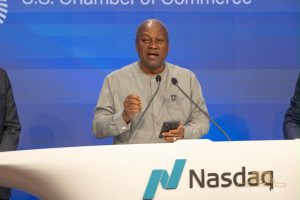
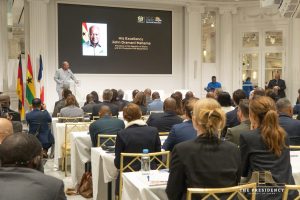
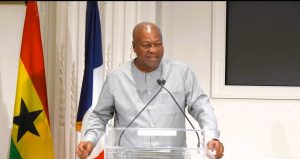
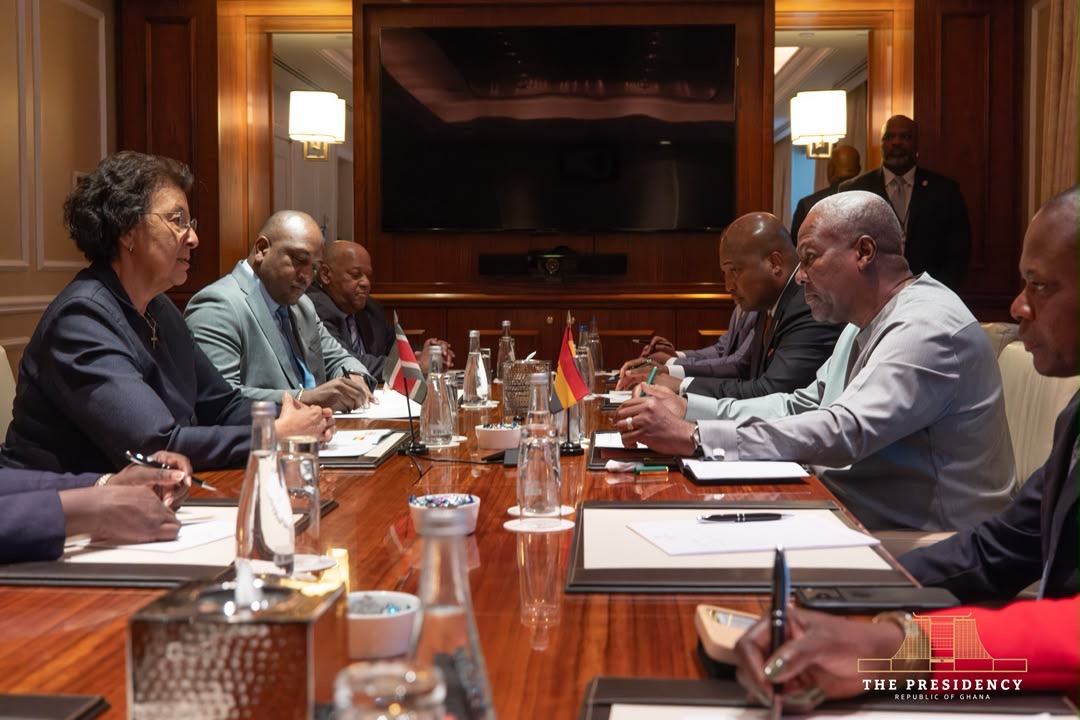
President Mahama made the call at the US-Ghana Presidential Roundtable organised by the US Chamber of Commerce and the US-Africa Business Center at NASDAQ in New York.
He said Ghana and the United States had built a strong partnership over the years, noting that trade in goods and services between the two countries reached approximately US$4.6 billion in 2025.
“The next chapter of this relationship must place greater emphasis on trade and investment, technology, and productive enterprise,” President Mahama said.
“American capital, American technology and experience can work with Ghanaian businesses and skills to produce goods and services for Ghana, Africa, and the world market.”
The President called for more American companies to establish production facilities in Ghana, source from Ghanaian businesses and share technology and expertise with local enterprises.
He said Ghana offered political stability, a strategic location in West Africa, natural and cultural resources, improving economic conditions and access to the wider African market.
President Mahama also drew attention to the African Continental Free Trade Area (AfCFTA), whose Secretariat is based in Accra, saying the continental market of more than 1.4 billion people presented opportunities for companies that produced in Ghana.
“Do not look at Ghana’s 34 million population only for what you can sell there. Look at Ghana for what you can produce and sell across Africa and to the world,” he told the business community.
President Mahama said Ghana had made progress in restoring macroeconomic stability, strengthening public finances and rebuilding confidence in the economy.
He said the economy grew by six per cent in 2025, while growth reached 6.4 per cent year-on-year in the first quarter of 2026. Inflation, he added, had fallen sharply before rising to five per cent.
He said the focus must now shift from stabilising the economy to increasing production, exports and employment.
“These gains matter, but stability is not an end in itself. We seek stability so businesses can plan with greater certainty. Investors can decide with greater confidence and productive enterprises can grow,” he said.
President Mahama called for lower interest rates and greater access to long-term financing to enable businesses to expand production and employ more people.
He also called for increased investment in agriculture, manufacturing, energy, infrastructure, technology and other productive sectors.
The President said the government’s 24-Hour Economy programme was central to efforts to increase production and create jobs.
He explained that the policy did not require every business to operate 24 hours a day, but was designed to enable enterprises with viable markets and commercial opportunities to introduce additional shifts and increase output.
“The 24-hour economy is not a directive requiring every business to remain open 24 hours a day. It is a framework that enables enterprises with a market and commercial basis to create additional shifts, raise outputs, and employ more people,” he said.
President Mahama said the government had established a 24-Hour Economy Authority to coordinate the programme and was putting measures in place to support qualifying businesses.
These measures include duty-free importation of plant and equipment and faster clearance procedures at the ports.
He said increased production would create opportunities in transport, logistics, warehousing, cold-chain facilities, digital services and other supporting sectors.
President Mahama said Ghana must produce more of the goods it currently imported where it had the capacity to do so, while expanding exports and creating more employment opportunities.
He said the country could no longer depend mainly on exporting raw commodities while importing finished products that could increasingly be produced locally.
“Ghana produces cocoa, gold, manganese, and many other commodities. Our farmers grow cashew nuts, shea fruits, vegetables, and grains, and yet too much still leaves our country in the raw form, while we import finished products that we could increasingly produce at home,” he said.
The President said agriculture offered clear opportunities for value addition, particularly in cocoa processing, cashew, shea, horticulture, grains, poultry, livestock and food manufacturing.
He explained that processing agricultural produce locally would create markets for farmers and jobs for processors, suppliers, transporters and other businesses along the value chain.
President Mahama invited American companies to explore opportunities in Ghana’s power sector, renewable energy, technology, agriculture, agribusiness, mining, health, pharmaceuticals and other productive sectors.
He said opportunities also existed in digital infrastructure, data centres, artificial intelligence, financial technology and other technology-enabled services.
“Ghana therefore welcomes American investment and technology in power generation, transmission, and distribution, in renewable energy and industrial energy solutions,” he said.
The President said reliable energy, efficient transport and logistics, and industrial infrastructure were necessary for businesses to expand and compete.
He said Ghana’s preparations to assume the chairmanship of the African Union in 2027 would also provide an opportunity to support continental efforts in infrastructure development, industrialisation, regional integration and implementation of the AfCFTA.
According to him, regional integration would require investment in roads, ports, reliable energy, digital connections and efficient borders, areas where American businesses could contribute their expertise and capital.
President Mahama said the two countries could build on existing economic ties and create a relationship in which Ghanaian and American businesses worked together to produce goods and services for Ghana, Africa and global markets.
He said Ghana’s strategic location and resources, combined with American capital, technology and business experience, could support a new phase of economic cooperation.
“We would like to see more American companies producing in Ghana, buying from Ghanaian suppliers, and sharing technology and knowledge with us,” he said.
The President said such cooperation would strengthen the economic relationship between Ghana and the United States while supporting productive enterprise and employment in Ghana.
Richard Aniagyei, ISD