President Mahama cuts sod for Sentuo expansion, unveils $3.5bn upstream investment and onshore drilling plans
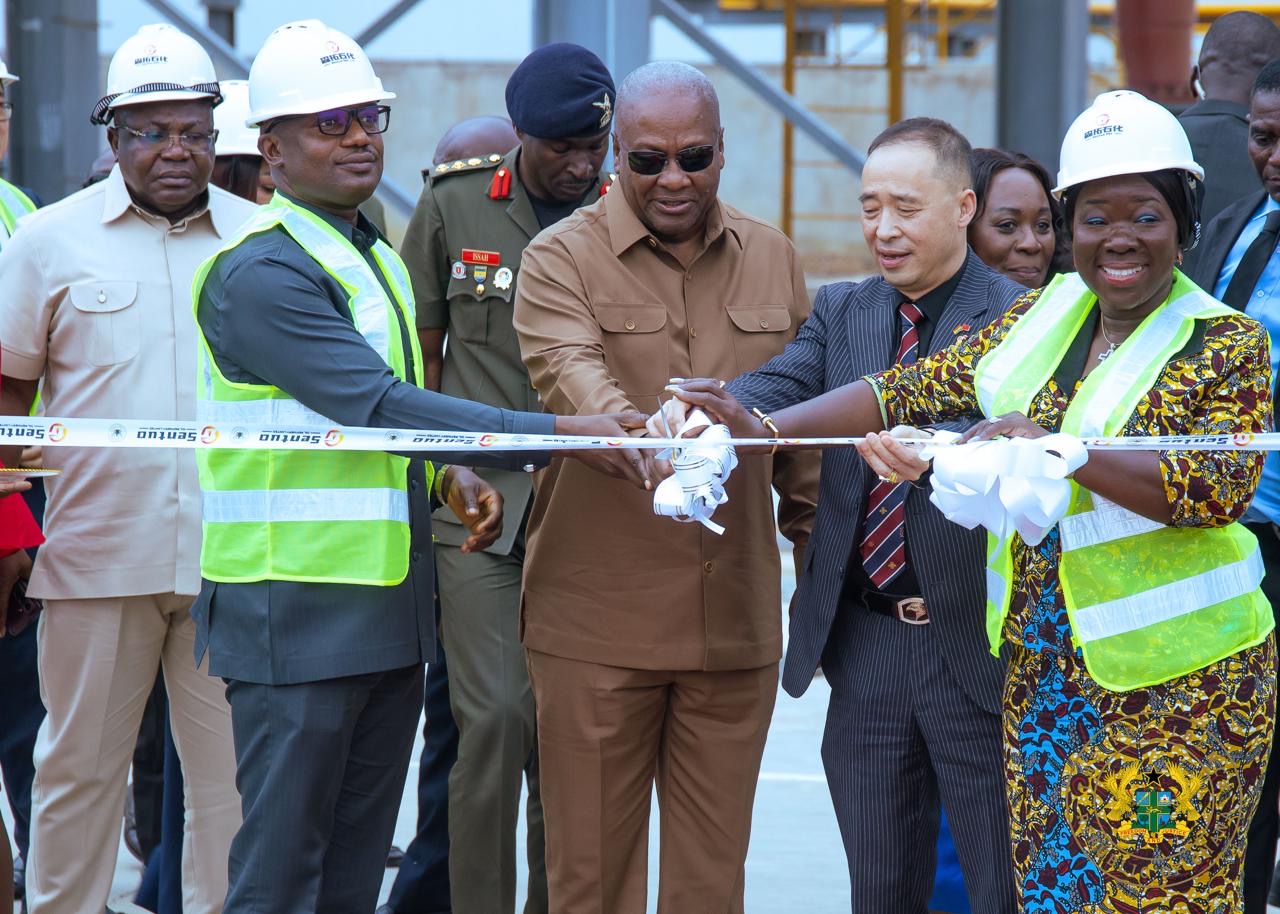
Sentuo Oil Refinery has broken ground on a Phase 2 expansion that will raise its total refining capacity from 40,000 to 100,000 barrels per day, as Ghana pushes ahead with a deliberate agenda to process more of its own crude oil domestically rather than export raw barrels and import finished petroleum products.
President John Dramani Mahama cut the sod for the expansion, describing it as a bold and strategic investment that came at a moment when Ghana’s economy was turning around and investor confidence was returning to productive sectors.
“By increasing domestic refining capacity, we reduce our dependence on imported refined petroleum products. We strengthen the reliability of our fuel supply chains. We retain more value within our economy and create opportunities for Ghanaian businesses and Ghanaian workers,” President Mahama said.
Alongside the sod cutting, the President announced that government had allocated one million barrels of crude oil from the Jubilee Field to Sentuo for domestic processing, describing the decision as deliberate and consistent with a policy direction that required Ghana to increasingly process its own resources and create value within its borders.
The expansion comes against the backdrop of a broader recovery in Ghana’s upstream petroleum sector. Production from the Jubilee field has risen from approximately 60,000 barrels per day to about 85,000 barrels per day, with the TEN and Sankofa fields also recording measurable output increases.
President Mahama said Ghana was poised to record an increase in crude oil production for the first time in several years, reversing a decline that had characterised the sector.
The recovery has been supported by $3.5 billion in upstream investment commitments secured by the government, including approximately $2 billion from the Jubilee partners for drilling up to 20 new wells and $1.5 billion from the OCTP partners for additional field development and exploration activities.
President Mahama also disclosed that the government had initiated the commercialisation process for the Afina Discovery, approved strategic amendments to the OCTP plan of development to enhance production, and ratified a new petroleum agreement in the offshore Tano West basin to support future reserve growth and long-term production.
In a development that could open an entirely new chapter in Ghana’s petroleum history, the President announced that ExploreCo, the operating arm of the Ghana National Petroleum Corporation, was set to begin onshore drilling in the Voltaian Basin before the end of the year.
“So far, all our discoveries have been offshore. We have discovered a lot of potential onshore, and GNPC, through ExploreCo, will start drilling wells to explore that oil before the end of this year,” President Mahama said.
On the downstream side, the President reported that the Tema Oil Refinery had completed its first major turnaround maintenance exercise in four years and had resumed crude oil processing.
He said plans were underway to enhance its operational efficiency and increase its refining capacity, and that in July, when the refinery had fully ramped up capacity, it would receive a parcel of Ghana’s own crude for processing.
President Mahama also acknowledged the role played by Sentuo Chairman Sute in maintaining adequate crude stocks during what he described as two months of crisis in the energy sector, saying the refinery had never stopped working throughout the period because of proactive stockpiling carried out on the instruction of the Energy Minister.
The Petroleum Downstream Sector Reform Committee has completed its work and submitted recommendations that are now being implemented, the President said, as part of broader reforms to improve efficiency, transparency and sustainability across the downstream sector.
President Mahama told investors and industry players that the ultimate goal was for Ghana to become a net exporter of refined petroleum products, saying when Sentuo completed Phase 2 and the Tema Oil Refinery was fully operational, the combined capacity would exceed domestic demand and allow the surplus to be exported to neighbouring countries.
“When Sentuo finishes Phase 2 and Tema Oil Refinery is fully operational, we will have more than enough to feed local demand, and we shall export the rest to our neighbouring countries,” he said.
He said that future would strengthen Ghana’s currency, improve its balance of payments, deepen industrial capacity and create opportunities for thousands of young Ghanaians, firmly establishing the country as a leading petroleum manufacturing and industrial hub in West Africa.
The President called for meaningful local content participation throughout the Sentuo expansion, saying Ghanaian companies must be involved across the value chain, with deliberate investment in skills development, strong partnerships with universities and technical institutions, and genuine technology transfer built into the project from the start.
He framed the entire expansion within the government’s Accra Reset agenda, which he described as a repositioning of Ghana from a nation that primarily exported raw materials to one that processed, manufactured, refined and created value within its own borders.
“Ghana should not be known merely as a producer of crude oil. Ghana should be recognised as a nation that refines, processes, and adds value to its resources, and also becomes a net exporter of petroleum products,” President Mahama said.
Richard Aniagyei, ISD